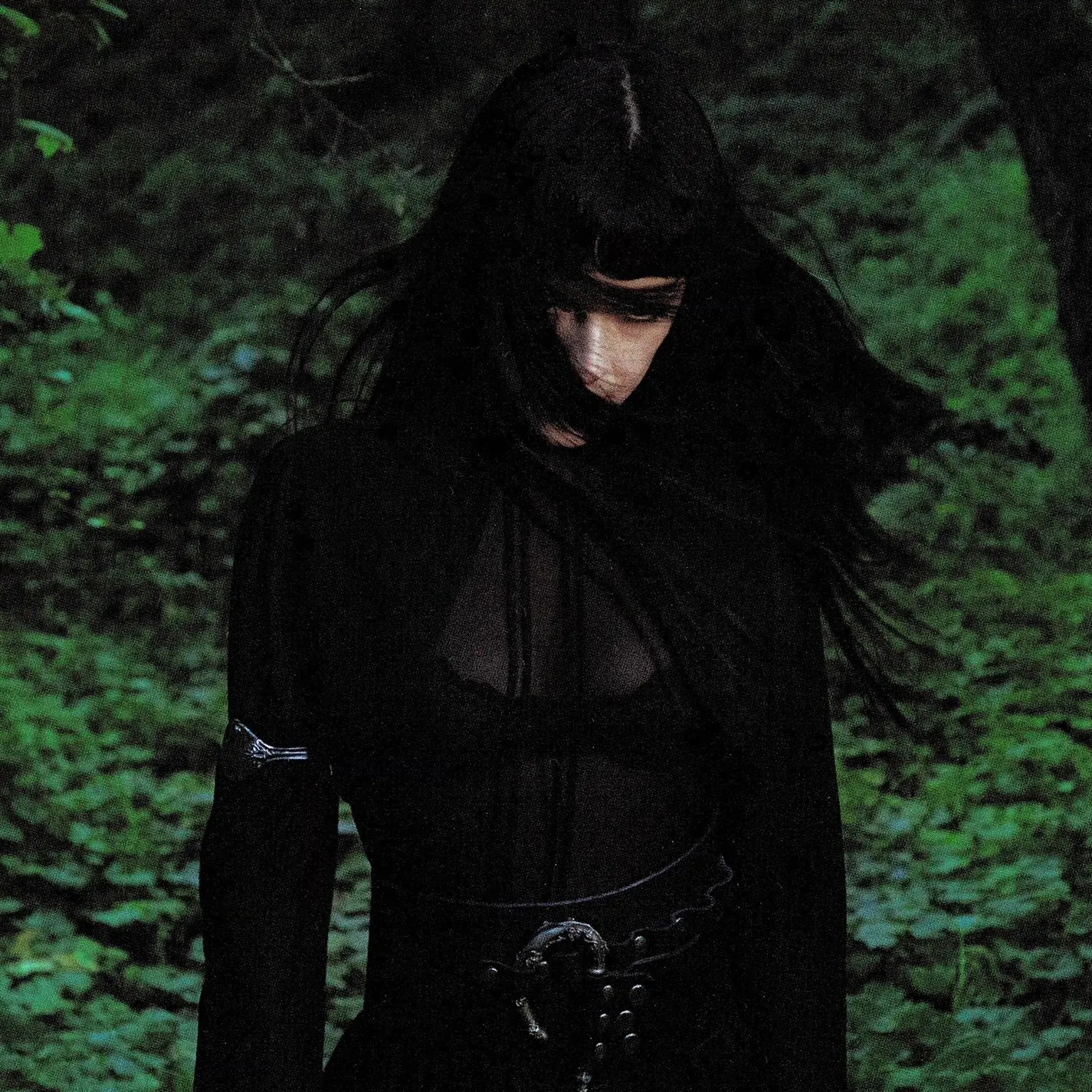
There are certain works that greet you when your soul is raw. Some things sink deep into your reality, fusing into the DNA of your pain and longing like a perfect match. Sometimes it feels as if they exist solely for you—a secret refuge cradled behind rib bones. Melt is that for me. The words, visuals, and sounds pulse in my chest. They sprout up and flower from my lungs like life itself. I seem to breathe and bleed this album. Melt is a secret: a whisper I can catch.
After María Zardoya announced her solo project in August of this year, calling it her “alternative reality,” I found myself entering that space with her. The world I once lived in had collapsed; now, I step into soil from the earth and bare skin. In tandem with Zardoya, I immerse myself in the rich visual world of dark muted colors, swans, blooming flowers, tree bark, and wooden pews. The haunted nature reflects the inside.
This healing journey sits at the heart of Zardoya’s solo project. She has spoken openly of her recent breakup and her hunger to confront the ache of love and loss on her own. She asks, “is love worth the pain,” I echo the question still scorched by an all-consuming love’s aftermath. Am I meant to give myself up again? Will I love as I had before? How will I know I’m ready? With stunning visuals and a soundscape steeped in the elements, this album dares you to plunge into open wounds.
I find that, as an “artist,” there is a need to capture feeling and emotion perfectly. Words are my only means of expression, but they often limit me, but it is all I have, a system of letters and a hope that it does my soul justice.
I found Melt to be an extension of myself—it helps me put words in the correct order. Zardoya expresses things I have not yet managed to write, aiding my process. The project is incredibly honest, raw, and vulnerable. When I write, everything is on full display: the things I hide in day-to-day dialogue, every emotion behind plain words, the ache, the tears, the pain, and the beauty in it all. In Melt, Zardoya does the same.
By the album’s core, Zardoya exposes her deepest nerves—fear in vulnerability, the acid sting of regret, grief’s hollow comfort, stumbling toward healing, and the tentative rediscovery of self. Each track pulls us into worlds soaked with watery reverb, heavy with brimming tears. Melting with her, we are always on the verge of breaking.
The opening track, “Puddles,” is rain and dripping water as we descend into the album. Zardoya’s voice is full of caution as she asks someone to love her, to want her—torn between craving intimacy and the terror of being in love again. “Puddles” is soft and tender, both sonically and lyrically, a perfect introduction to the themes of Melt. We hear the question, is love worth the pain? and the deathly fear of what happens after you dare to fall again.
As the album unfolds, the emotional tension shifts. We explore what this persistent question evokes in Zardoya and, in all honesty, in me. Uncertainty stretches into vulnerability, and intimacy is tinged with fear.
“Moment” and “Not the Only One” are where I find myself suspended—a complicated stage of healing. Someone new is introduced, but the past lingers. In “Moment,” we explore fragments of a new relationship. She feels her walls come down. She wants to let new love in. “In this moment I break, in this moment I want more… but this moment will change and I’ll never be all yours.” These repeated lines reveal the core conflict: love will hurt and I’m not ready to crash again. I barely survived the last time.
The opening line of “Not the Only One” is excruciatingly honest: “Babe, you can’t say I didn’t try // This pain almost made me wanna die.” At this step in the process, this is the best she can do. Moving on with someone new is difficult when the ghost of the past still lingers. She is able to promise her new partner physical loyalty, but can’t promise much more.
“Back to You” and “Magnet” are for the moments my soul feels stretched from my body, hollowing my chest. I think it is still looking for them. Hope is both the ultimate wish and ultimate prison. “Back to You” is the acceptance, so to speak. The acknowledgement that it didn’t work out in this life. But that hurts too much to accept. So maybe in a parallel universe, we are together. Perhaps that will ease the ache. It’s a trap: “Until then, I’m wasting time // Until I’m yours again… I can learn how to fly // so I’ll be yours again.” She is willing to do the impossible to get back what she lost. She waits, letting feelings for others come and go, knowing nothing will ever compare.
“Magnet” is the call and a promise. In “Magnet,” she finds her lover in dreams. She leaves messages of her love in trees outside their window, all while keeping the promise of distance. I did this with the moon and budding flowers in late June. Maybe we do it to ourselves. But where else should the love go? It can’t stay trapped inside the body only to rot.
The best way to describe these two songs is “tortured,” as is “Water on Your Nose.” In this one, she longs for her partner’s physical closeness. She imagines their hand in hers. A repeated line closes the song: “I don’t have to try to love you // It comes easy to me.” Another call and another promise.
“My Turn” aches with apology. I grip this song tight because it tastes more sincere than the apology I received. Zardoya names her guilt, confessing, “Most all I think about is how I did you wrong // and how I paid for it.” She mourns the piece of herself that died: “I died when I lost // you.” This is the solace I crave—her words remind me I didn’t deserve the wound I carry.
“Vueltas” is special, not just because it’s the lone track in Spanish, but also as the first mention of self-love. I won’t say that self-love is the main theme in “Vueltas,” nor is it meant to be. She has become so used to this person as an extension of herself that now there are questions she wants answered: What happens when we finally let each other go? What will be left? She turns these hypotheticals around in her head and finds only one outcome: “que no queda más que amarme más // amarme más en mí // sin ti.” There is nothing left but to love myself more, within myself, without you. It’s the scariest conclusion, in my opinion, one I’ve explored at length and still find more to uncover. It takes a lot to choose yourself in this mess, rather than slip into bad habits or tired routines. We try our best with what we’re given, I suppose.
I’ll close out with “Swan,” another pillar track of the album. “Swan” is the search for that forever love. Zardoya has returned to the swan—a symbol of devotion and loyalty for life—across multiple projects. The song reveals her desire for a relationship she will devote the rest of her life to—mind, body, and soul. Even with the aspiration of new love at the forefront of the song, it’s not without lingering hurt: “If you hold me like he hurt me // I will save you the last dance.” There is always a dance of comparison. Almost impossible to separate herself from it; she carries the hurt like a child holds onto a blanket. I hold on. I sort through moments in my head in an attempt to make sense. In an attempt to ease wounds kept raw.
Melt is a perfect portrait of the healing and grieving process. As I attempt the same processes, not far from my now ex-partner, I face the same questions and internal conflicts almost daily. Distance and time never seemed as kind as they look now. Melt is an album that exhibits the heart’s agenda, where logic does not need to lead, and is dedicated to those of us who wear it on our sleeves.
I return to the question: Is love worth the pain? I can’t say I’ve arrived at an exact answer, but I think the answer should probably be yes. Regardless of the pain inflicted by someone who was hurting, the process of love was all the same. In it was trust and a kind affection, intimate breath and a choice made every day. If I survived once, I’m sure the process of surviving gets easier. One day, I will again be able to put my heart in the hands of another and hope they will not squeeze too tight.
